Why Flutter Has Become the Go-To Choice for Modern App Development

Mobile apps today aren’t just about working on a screen, they’re about speed, experience, and scalability. Users expect apps to load instantly, feel smooth, and look consistent whether they’re on iOS or Android. For businesses, that means building faster, launching smarter, and staying flexible as products evolve. This shift is exactly why Flutter app development has moved from “interesting option” to a serious first choice in modern app development.
Powered by Google, the Flutter framework allows businesses to build high-quality apps for multiple platforms using a single codebase, without sacrificing performance or design. Instead of managing separate teams for iOS and Android, companies can focus on shipping features faster and improving user experience. In a market where time-to-launch and consistency matter more than ever, that advantage is hard to ignore.
As more brands weigh Flutter vs native development, the conversation is no longer just about cost savings. It’s about speed, maintainability, and long-term growth. From startups validating their first idea to enterprises scaling complex products,
Flutter is proving it can handle real-world demands. And that’s the real reason many teams now ask a simple question: why choose Flutter for app development at all? The answer lies in how well it fits the way apps are built and expected to performtoday.
What Flutter Is and Why It Fits Modern App Development
Flutter is Google’s open-source UI framework used for building iOS and Android apps from a single codebase using the Dart programming language. Instead of relying on web views or heavy native bridges,
Flutter compiles directly into native code, delivering smooth performance and a consistent UI across platforms. For brands looking to move fast without compromising quality, Flutter has become a practical choice in modern app development.
Why Flutter fits today’s app needs:
- Single codebase for iOS & Android → faster development and lower cost
- Native-like performance without complex native setups
- Widget-based UI for consistent design across devices
- Hot reload feature for quicker updates and iterations
- Faster time-to-market for startups and growing products
- Scales well for long-term app maintenance and enterprise use
Real-World Use Cases: Where Flutter Works Best
Flutter isn’t just for “demo apps” or scrappy MVPs anymore. It’s powering real products across industries where speed, performance, and consistency actually matter.
- Startups & MVPs: Flutter is a favorite for startup app development because it cuts build time almost in half. One codebase, faster launches, quicker pivots, ideal when you’re testing ideas and racing the market.
- Ecommerce & Retail Apps: From product catalogs to checkout flows, Flutter handles complex UI and animations smoothly. Brands use it to deliver fast-loading, visually consistent shopping experiences on both iOS and Android.
- Fintech & Banking Apps: Security, performance, and UI precision are critical here. Flutter’s native-like performance and controlled UI rendering make it a strong fit for finance apps, wallets, and dashboards.
- Enterprise Mobile Solutions: Large organizations use Flutter for internal tools, CRM apps, and workforce solutions where scalability and long-term app maintenance matter more than flashy features.
- On-Demand & Service Apps: Food delivery, logistics, healthcare, and booking apps benefit from Flutter’s smooth navigation, real-time updates, and performance optimization.
- Content-Heavy & Media Apps: Flutter handles dynamic content, video, and custom layouts well, making it suitable for news, education, and streaming-style applications.
Big brands like Google Pay, BMW, Alibaba, and eBay Motors have adopted Flutter, not because it’s trendy, but because it delivers reliable mobile app performance at scale.
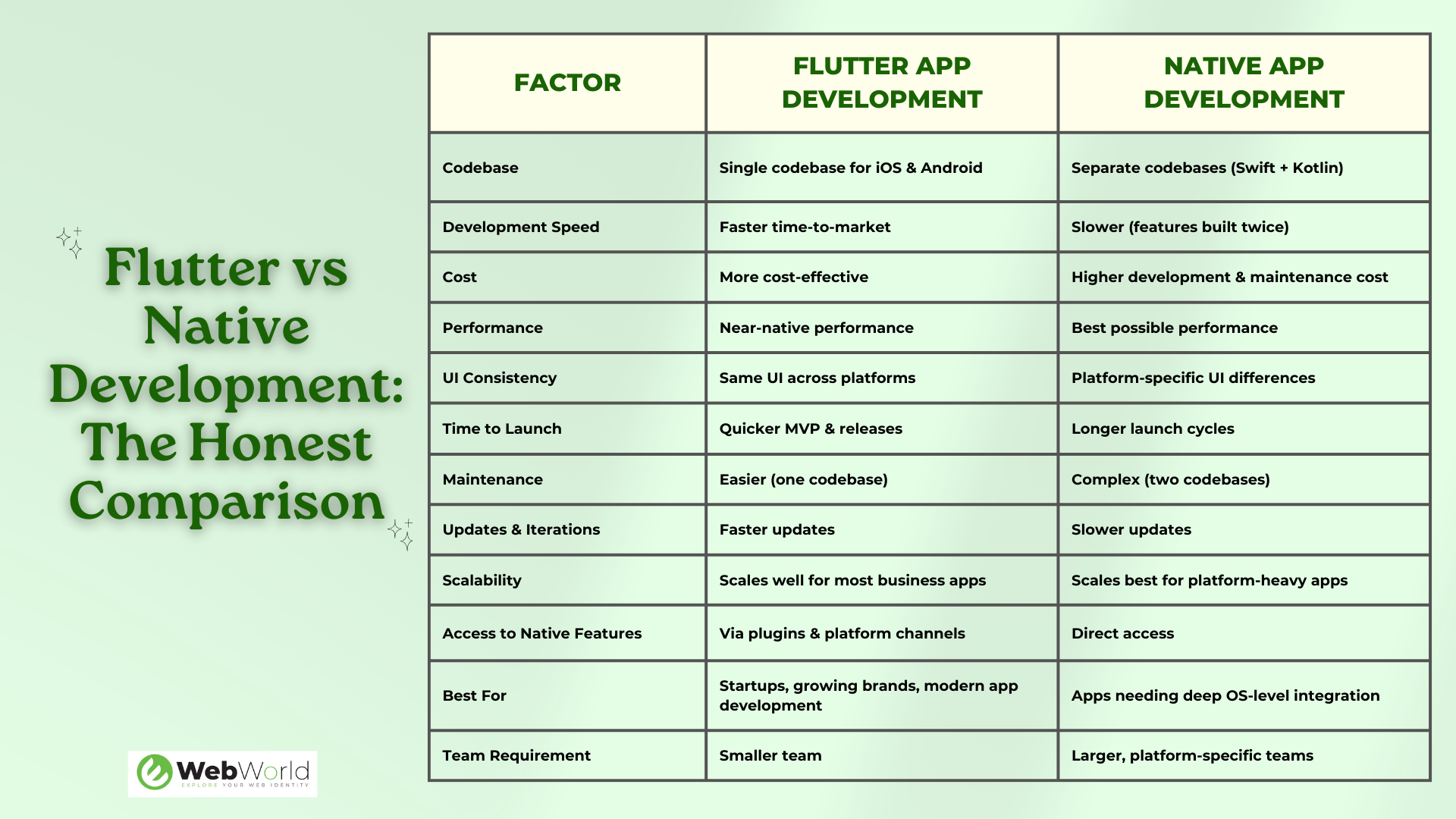
Flutter vs Native Development: The Honest Comparison
| Factor | Flutter App Development | Native App Development |
|---|---|---|
| Codebase | Single codebase for iOS & Android | Separate codebases (Swift + Kotlin) |
| Development Speed | Faster time-to-market | Slower (features built twice) |
| Cost | More cost-effective | Higher development & maintenance cost |
| Performance | Near-native performance | Best possible performance |
| UI Consistency | Same UI across platforms | Platform-specific UI differences |
| Time to Launch | Quicker MVP & releases | Longer launch cycles |
| Maintenance | Easier (one codebase) | Complex (two codebases) |
| Updates & Iterations | Faster updates | Slower updates |
| Scalability | Scales well for most business apps | Scales best for platform-heavy apps |
| Access to Native Features | Via plugins & platform channels | Direct access |
| Best For | Startups, growing brands, modern app development | Apps needing deep OS-level integration |
| Team Requirement | Smaller team | Larger, platform-specific teams |
Choosing Between Flutter and Native: A Quick Summary
Flutter app development uses a single codebase for both iOS and Android, helping businesses launch faster, reduce development costs, and maintain a consistent UI across platforms. Native app development relies on separate codebases (Swift for iOS and Kotlin for Android), offering maximum performance and deep platform control but with higher costs and longer development cycles.
Why Businesses Choose Flutter for Modern App Development
- One codebase for iOS and Android apps
- Near-native performance with smooth, responsive UI
- Faster development and shorter time-to-market
- Easier app maintenance and long-term scalability
- Cost-effective for startups and growing businesses
Best Use Cases
- MVPs and rapid prototyping
- Startup and enterprise mobile solutions
- Apps requiring strong UI consistency across platforms
Native development is better suited for hardware-intensive apps or highly platform-specific features.
Final Thoughts: Is Flutter the Right Choice for Your App?
Flutter isn’t a trend anymore, it’s a proven framework powering real-world apps for startups, scale-ups, and enterprises alike. If your goal is to launch faster, control costs, maintain consistent UI across platforms, and still deliver near-native performance, Flutter app development makes a lot of sense in today’s market.
That said, the “right” choice always depends on what you’re building. For most modern app development needs, MVPs, consumer apps, SaaS products, and enterprise mobile solutions, Flutter offers the speed, flexibility, and scalability businesses need in 2025 and beyond. Native development still has its place, but for many brands, Flutter strikes the best balance between performance and practicality.
The real win is choosing the right tech early saves months of rework, wasted budgets, and future limitations.
For a deeper understanding of Flutter development, explore our complete Flutter app development guide covering everything from setup to deployment.
Ready to Build with Flutter?
At eWebWorld, we help businesses turn ideas into high-performing mobile apps using the Flutter framework. From strategy and UI/UX to development, testing, and scaling, we build apps that are fast, reliable, and future-ready.
If you’re planning an MVP, upgrading an existing app, or launching a full-scale product, our Flutter developers are here to help you do it right the first time.
Let’s build a Flutter app that’s ready for growth. Talk to our mobile app experts today.
People Also Ask
1. What is Flutter and why is it so popular for app development?
Flutter is a UI framework by Google that lets you build iOS and Android apps using a single codebase. It’s popular because it speeds up development, keeps costs in check, and delivers a smooth, near-native experience. For businesses, that means faster launches without sacrificing app quality.
2. Is Flutter good for modern app development in 2026?
Yes, very much so. Flutter fits perfectly with modern app development needs like mobile-first design, fast performance, scalable architecture, and consistent UI across platforms. It’s especially well-suited for startups, SaaS products, and brands that want to iterate quickly without rebuilding everything from scratch.
3. How does Flutter compare to native app development?
Flutter uses one codebase for both platforms, which makes development and maintenance easier. Native development uses separate codebases (Swift for iOS and Kotlin for Android), offering maximum platform control but at a higher cost and longer timelines. Flutter is often the smarter choice unless your app relies heavily on platform-specific hardware features.
4. Can Flutter apps deliver native-like performance?
In most real-world use cases, yes. Flutter apps are compiled directly to native code and use their own rendering engine, which results in smooth animations and fast UI responses. While pure native apps still have a slight edge for hardware-intensive tasks, Flutter performs more than well enough for most business applications.
5. Why do businesses choose Flutter over React Native?
Many businesses prefer Flutter because of its consistent UI across devices, better performance stability, and fewer dependency issues. Flutter’s widget-based approach gives designers and developers more control, while React Native relies more heavily on native components, which can behave differently across platforms.
6. Is Flutter a good choice for startups and MVPs?
Absolutely. Flutter is ideal for MVPs because it reduces development time, lowers costs, and allows quick iteration based on user feedback. Startups can validate ideas faster and scale later without needing to rebuild the app for another platform.
7. Do I need experienced Flutter developers to build a quality app?
Yes, and this part matters. While Flutter simplifies development, building a scalable, high-performance app still requires strong architecture, UI planning, and performance optimization. Working with experienced Flutter developers ensures your app doesn’t just launch fast, but also grows smoothly over time.

About The Author
Nidhi writes content at eWebWorld and has a knack for making tech talk sound human. With 3+ years of experience in content creation, she’s all about cool web trends, clean UI, and turning geeky stuff into scroll-worthy reads. When she’s not writing about web development or UI/UX trends, she’s probably diving into creative inspiration like exploring new tools or sketching ideas for her next blog.
Search
Popular Posts




Follow us

Recent Posts

About eWebWorld
eWebWorld is a Shopify and eCommerce development company in India with 10+ years of experience building and scaling online stores. We specialize in Shopify development, including store setup, customizations, theme development, migrations, integrations, and performance optimization. Through our expertise in eCommerce, technology, and digital marketing, we help businesses create better online experiences and achieve sustainable growth.